
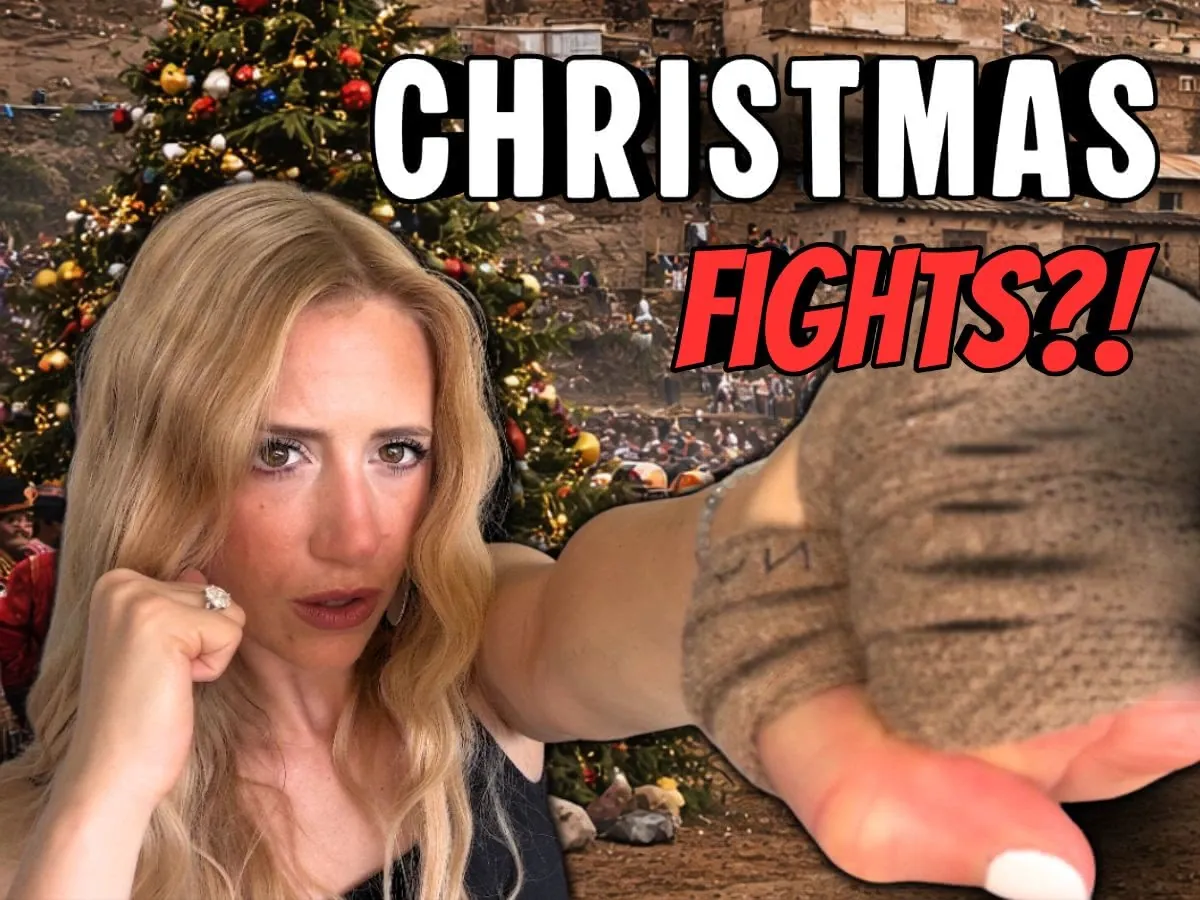
Snow falls and children across America wake up and race down the stairs, eager to tear open Christmas gifts waiting beneath the tree. Parents smile with warmth as they sip coffee, watching wrapping paper scatter across the floor while laughter fills the house.
Meanwhile, in Takanakuy Peru, the sun beats down on a dusty Andean town where a very different kind of Christmas unfolds. Villagers wrap their hands in gloves, tightening the fabric carefully as they prepare to fight, while masked faces move through crowds pulsing with anticipation. A fist flies, the crowd erupts, and just like that, the ritual begins.
This is the Peru Christmas Fighting Festival, known as Takanakuy Peru, a tradition that captures global attention every single year. To outsiders, it looks shocking, but within the community, it represents a fresh start before the new year begins.

 19
19
 13
13
In Takanakuy Peru, the annual fighting festival takes place every year on December 25, transforming Christmas Day into a ritual of conflict resolution. The festival occurs mainly in Santo Tomás, the capital of Chumbivilcas Province in the Cusco region of southern Peru, where the tradition has been preserved for generations. The word Takanakuy comes from the Quechua language and translates to “to hit each other,” a literal description of what takes place in the town’s central plaza.
As villagers prepare to fight, the energy in Santo Tomás builds long before the first match begins. Crowds gather to dance, drink, and celebrate as traditional Huaylía music echoes through the streets, setting the rhythm for the day ahead. What may look like chaos from afar is actually preparation for a ritual with a very clear purpose: to settle unresolved disputes before the new year begins.
It’s important to clarify that Takanakuy Peru is not practiced across Peru as a whole, despite what viral headlines sometimes suggest. This tradition is rooted in specific Andean communities, particularly in Chumbivilcas Province, where generations have maintained the ritual as part of their cultural identity. Outside of this region, most Peruvians experience Christmas in ways that look far more familiar to Western audiences.
The heart of Takanakuy Peru is the remote mountain town of Santo Tomás, located deep within the Andes in the Cusco region. While the broader area is internationally known for nearby destinations like Cusco city and Machu Picchu, Santo Tomás itself remains small, rural, and deeply connected to traditional ways of life. Its isolation helped shape the conditions that allowed this unusual tradition to survive.
Crowds swell as spectators gather from surrounding communities, with attendance reaching upwards of 3,000 people each year. Historically, the region’s remote geography meant limited access to formal courts and legal systems, leaving communities to find their own solutions to disputes.
Over time, Takanakuy Peru became that solution, offering a structured way to resolve conflicts in full view of the community. Instead of lingering grudges or quiet resentment, disagreements were confronted directly and decisively. For many locals, this tradition is about closure, accountability, and the chance to begin the new year without unfinished business.
The Origins of Takanakuy Peru

The exact origins of Takanakuy Peru are difficult to trace to a single year, but historians believe the tradition dates back several centuries. Many scholars point to the colonial period, when rural Andean communities had little access to formal justice systems or legal authorities. Disputes often lingered unresolved, sometimes lasting for years without intervention.
During this time, communities developed their own methods of maintaining social order. Instead of allowing resentment to build quietly, disagreements were settled publicly through controlled combat. Over generations, this system evolved into what is now recognized as Takanakuy Peru, blending indigenous traditions with colonial-era influences.
Some researchers also suggest that ritual combat has roots in older Andean customs, where symbolic fighting played a role in restoring balance within communities. These traditions emphasized accountability, courage, and reconciliation, values that remain visible in modern celebrations of Peru Fighting Festival events. Today, the festival continues as both a cultural tradition and a living example of community-based conflict resolution.
Why People Fight During The Peru Fighting Festival

At first glance, the idea of a Peru Christmas Fighting Festival sounds shocking. Christmas is widely associated with peace, generosity, and togetherness, making the concept of organized fighting feel contradictory. However, in Takanakuy Peru, fighting is not random aggression, instead serving as a structured social purpose.
Throughout the year, tensions naturally arise within small communities. Disputes may involve land boundaries, unpaid debts, jealousy, broken promises, or personal disagreements that cannot easily be ignored. Instead of allowing resentment to grow over time, community members use Takanakuy Peru as an opportunity to address these issues directly.
The psychology behind this tradition centers on controlled emotional release. By confronting conflict openly, participants reduce long-term hostility and restore social harmony. Once the fight concludes, the dispute is considered settled, allowing both individuals and the wider community to move forward.
Does Takanakuy Peru Actually Work?

Supporters of Takanakuy Peru strongly believe the tradition works as intended. They argue that public conflict resolution prevents long-standing feuds and reduces ongoing hostility between neighbors. In tightly connected communities, unresolved disputes can disrupt daily life, making closure essential for maintaining peace.
After the fight ends, participants are expected to reconcile. Many fighters shake hands or embrace, signaling that the conflict has officially ended. This ritual reinforces the idea that fighting is not meant to create division but rather to eliminate lingering tension.
Critics, however, raise concerns about safety and fairness. Injuries do occur, ranging from bruises and cuts to more serious harm in rare cases. Some also question whether physical strength can influence outcomes, potentially favoring stronger participants over weaker ones.
Despite these criticisms, Takanakuy Peru continues each year, supported by the communities that rely on it. The persistence of the tradition suggests that many locals believe its benefits outweigh its risks.
The Rules of the Christmas Fighting Festival

Although Takanakuy Peru may appear wild to outsiders, the fights follow clear and enforced rules. Fighters enter the ring one pair at a time, and referees remain present throughout the match to maintain order. The structured environment ensures that conflict remains controlled rather than chaotic.
Participants are allowed to punch, kick, and grapple during the match. However, certain actions are strictly prohibited, including biting, hair pulling, or attacking someone who has fallen to the ground. If a rule is broken or the fight becomes unsafe, referees intervene immediately.
At both the beginning and end of the fight, participants acknowledge one another with gestures of respect. These moments reinforce the idea that the event is ritualistic rather than purely violent. The goal is not humiliation, but resolution.
Who Participates in Takanakuy Peru?

One of the most surprising aspects of Takanakuy Peru is the wide range of participants involved. Fighters include adult men and women, teenagers, and sometimes even children in supervised matches. Participation is voluntary, and individuals choose to fight either to settle disputes or to demonstrate personal strength.
In many cases, fights between younger participants are symbolic rather than intensely competitive. These early experiences introduce younger generations to the cultural traditions of their community. Over time, participation becomes a way of reinforcing shared values and identity.
Older participants may also engage in symbolic matches, especially when disputes are less severe. This flexibility allows the tradition to adapt to different circumstances while maintaining its cultural significance.
The Festivities Surrounding The Peru Fighting Festival

Takanakuy Peru is far more than a sequence of fights. The festival begins with parades, dancing, and music, transforming the town into a vibrant stage filled with sound and movement. Huaylía music, a traditional Andean style, plays continuously as dancers perform elaborate routines.
Participants often wear colorful costumes and masks during the festivities. Historically, masks allowed individuals to challenge powerful members of the community without fear of retaliation outside the festival. Over time, these costumes became symbols of tradition and theatrical expression.
Food and drink play an important role throughout the day. Families gather to share meals, celebrate victories, and reconnect with neighbors. The festive atmosphere ensures that Takanakuy Peru remains a celebration as much as a ritual.
Why Christmas Day Holds Special Meaning in Takanakuy Peru
The choice to hold Takanakuy Peru on Christmas Day carries deep symbolic meaning. Christmas is widely associated with renewal, forgiveness, and reflection, making it an ideal moment to resolve lingering conflicts. By settling disputes on December 25, participants symbolically leave past grievances behind.
This timing also prepares individuals and families for the coming year. Entering a new year without unresolved tension strengthens community relationships and promotes long-term stability. In this way, Takanakuy Peru transforms Christmas into a moment of emotional renewal.
While the methods may differ from Western traditions, the underlying message remains familiar. Forgiveness, reconciliation, and fresh beginnings are universal values shared across cultures.
Tourism and Global Attention on Takanakuy Peru
In recent decades, Takanakuy Peru has drawn increasing international attention. Journalists, researchers, and travelers have traveled to Santo Tomás to witness the Peru Fighting Festival firsthand. Documentaries and news coverage have further amplified global curiosity about the event.
Despite this attention, the festival remains primarily local in nature. It is not staged for tourists, nor has it transformed into a large-scale commercial attraction. Instead, visitors who attend are witnessing a living tradition that continues to serve its original purpose.
This authenticity is one of the reasons Takanakuy Peru remains so compelling. It represents culture in motion, preserved through participation rather than performance.
Christmas in America vs Takanakuy Peru
In America, Christmas is often defined by warmth and comfort. Homes glow with decorative lights, families exchange gifts, and meals stretch long into the evening. The day unfolds slowly, filled with laughter, rest, and shared traditions.
In Takanakuy Peru, Christmas unfolds in a dramatically different setting. Crowds gather in open plazas surrounded by mountains, music echoes through narrow streets, and fighters step forward to resolve unfinished disputes. Dust rises into the air as the community watches each match with intense focus.
Yet despite these visible differences, both traditions share a deeper purpose. Each aims to restore peace and strengthen relationships. Whether through gift-giving or ritual combat, the ultimate goal remains the same, unity moving into the new year.
A Different Kind of Peace
Return once more to that familiar Christmas morning scene in America. Children laugh as they open presents, parents exchange smiles, and the room fills with warmth and celebration. The day feels calm, comforting, and predictable.
Now return to Takanakuy Peru, where the final fight of the day comes to an end. Two opponents stand face to face, breathing heavily, their faces marked by effort and exhaustion. Slowly, they extend their hands and acknowledge one another in front of the cheering crowd.
In that moment, peace is restored through confrontation. The conflict has ended, the grievance has been settled, and the new year can begin without unfinished business. That is what makes Takanakuy Peru, the Peru Christmas Fighting Festival, one of the most fascinating and unexpected cultural traditions in the world.